
May 4, 2026
📋 Table of Contents
- Why India Dominates the Global Onion Trade
- Largest Producer of Onion in India — State by State
- Onion Varieties in India That Exporters Must Know
- Types of Onion in India — A Practical Buyer's Breakdown
- How to Find Reliable Onion Suppliers in India
- Onion Manufacturers in India — What to Look For
- The Onion Export Process: Documents, Standards & Shipping
- Meet Jenika Enterprise — Your Trusted Onion Export Partner
- Frequently Asked Questions
Why India Dominates the Global Onion Trade
There's a running joke in the Indian food industry: when onion prices rise, governments fall. That's how central the onion is to daily life here. But beyond the domestic drama, there's a quieter, more powerful story unfolding — one about how India has quietly become the world's most important player in onion export, year after year, across dozens of countries.
India is the second-largest producer of onions globally, right after China. But here's what makes it special for international buyers: unlike China, India actively exports. Massive volumes of Indian onions move to Malaysia, Sri Lanka, Bangladesh, the UAE, the UK, and increasingly to Europe and Southeast Asia every single year. The onion export industry from India is worth hundreds of millions of dollars — and it's growing.
What gives Indian onions such a competitive edge? A few things come together perfectly: diverse agro-climatic zones that allow harvesting almost year-round, a wide range of onion varieties in India suited to different culinary and processing needs, a deeply experienced farmer base, and an increasingly professional network of onion suppliers in India who understand international quality standards.
If you're an importer, a food distributor, or a bulk buyer looking to source onions from India, this guide is written for you. We'll walk through everything — the producing states, the varieties, how to identify credible onion manufacturers in India, the documentation you'll need, and the questions you should absolutely ask before signing a contract.
Largest Producer of Onion in India — State by State
If you want to understand onion export from India, you have to understand where the onions actually come from. India's onion belt is concentrated in a handful of states, each with its own climate, soil type, and harvest calendar. Knowing this geography will help you plan procurement timelines and avoid the feast-or-famine cycles that catch new importers off guard.
| State | Key Districts | Main Harvest | Production Share |
|---|---|---|---|
| Maharashtra 🥇 | Nashik, Pune, Ahmednagar, Solapur | Oct – Dec & Mar – May | ~40% |
| Madhya Pradesh | Indore, Ratlam, Shajapur | Mar – May | ~15% |
| Karnataka | Gadag, Dharwad, Belgaum | Dec – Feb | ~12% |
| Gujarat | Bhavnagar, Amreli, Rajkot | Jan – Mar | ~10% |
| Rajasthan | Alwar, Jaipur, Sikar | Mar – May | ~9% |
| Andhra Pradesh | Kurnool, Anantapur | Dec – Feb | ~8% |
| Bihar & Others | Patna, Nalanda | Mar – Apr | ~6% |
Nashik: The Onion Capital of India
Ask anyone in the agri-trade industry and they'll tell you: Nashik is where Indian onion export begins. This district in Maharashtra's Vidarbha-adjacent belt produces onions in such quantities that it has its own wholesale market — the Lasalgaon APMC — which is Asia's largest onion trading yard. On peak days, thousands of tonnes change hands here before the sun is even fully up.
The largest producer of onion in India is Maharashtra by a wide margin, contributing roughly 40% of the country's total output. But what makes Maharashtra truly dominant in the export context is not just volume — it's the quality and keeping quality of its onions. Nashik onions are known internationally for their firm flesh, sharp pungency, and long shelf life, which makes them ideal for sea freight across long distances.
Why the Staggered Harvest Calendar Matters
One thing experienced importers quickly learn is how to read India's multi-season harvest calendar. Because different states harvest at different times, a savvy buyer can source fresh Indian onions for nine to ten months of the year — not just in a single peak window. Madhya Pradesh fills the March–May gap, Karnataka bridges December to February, and Gujarat covers January–March. Understanding this stagger is the difference between a buyer who scrambles during supply crunches and one who plans quarters in advance.
Onion Varieties in India That Exporters Must Know
Not all Indian onions are the same — not even close. The onion varieties in India span a remarkable spectrum of colour, size, pungency, and shelf life. Choosing the right variety for your market is one of the most consequential decisions you'll make as an importer. Get it right and your customers keep coming back. Get it wrong and you'll spend weeks fielding complaints about onions that rot too fast or taste too mild for local cuisine.
Nashik Red (Agrifound Dark Red)
The variety that built India's export reputation. Deep red skin, tight concentric layers, sharp pungency, and outstanding shelf life of 4–6 months. The default choice for most onion export shipments to Southeast Asia and the Middle East.
Bhima Kali
A NHRDF-developed variety with striking dark purple skin and high dry matter content. Excellent for processing and dehydration. Popular among onion manufacturers in India who produce dehydrated onion flakes and powder.
Bhima Super
Round, medium-sized, and relatively mild. Preferred by buyers in the UK and European Union who serve markets with milder taste preferences. Good yield, reasonable shelf life, and attractive visual presentation.
White Onion (Pusa White)
Snow-white skin, mild and sweet flavour, very low pyruvic acid. Commands a premium price in export markets — particularly the US, Canada, and parts of the Gulf — for use in salads, salsa, and pickles.
Yellow / Brown Onion
Widely used in food processing for caramelised and fried onion products. Grown in Rajasthan and parts of Gujarat. Reliable yield, good sugar content, and favoured by food-grade onion manufacturers in India for industrial use.
Agrifound Light Red
An NHRDF variety with a lighter red skin, flatter shape, and excellent resistance to thrips and purple blotch disease. Popular in Karnataka and Andhra Pradesh. A practical, reliable workhorse variety for volume exports.
Spring Onion / Shallots
Smaller bulbs, milder flavour, and widely used in Asian cuisines. India exports shallots primarily to Sri Lanka, Singapore, and Southeast Asia. A high-value, lower-volume niche with strong repeat demand.
Bhima Raj & Bhima Shakti
Newer NHRDF releases bred for high yield and disease resistance. Being rapidly adopted by progressive farmers in Maharashtra and Madhya Pradesh. Likely to feature more heavily in export consignments over the next few seasons.
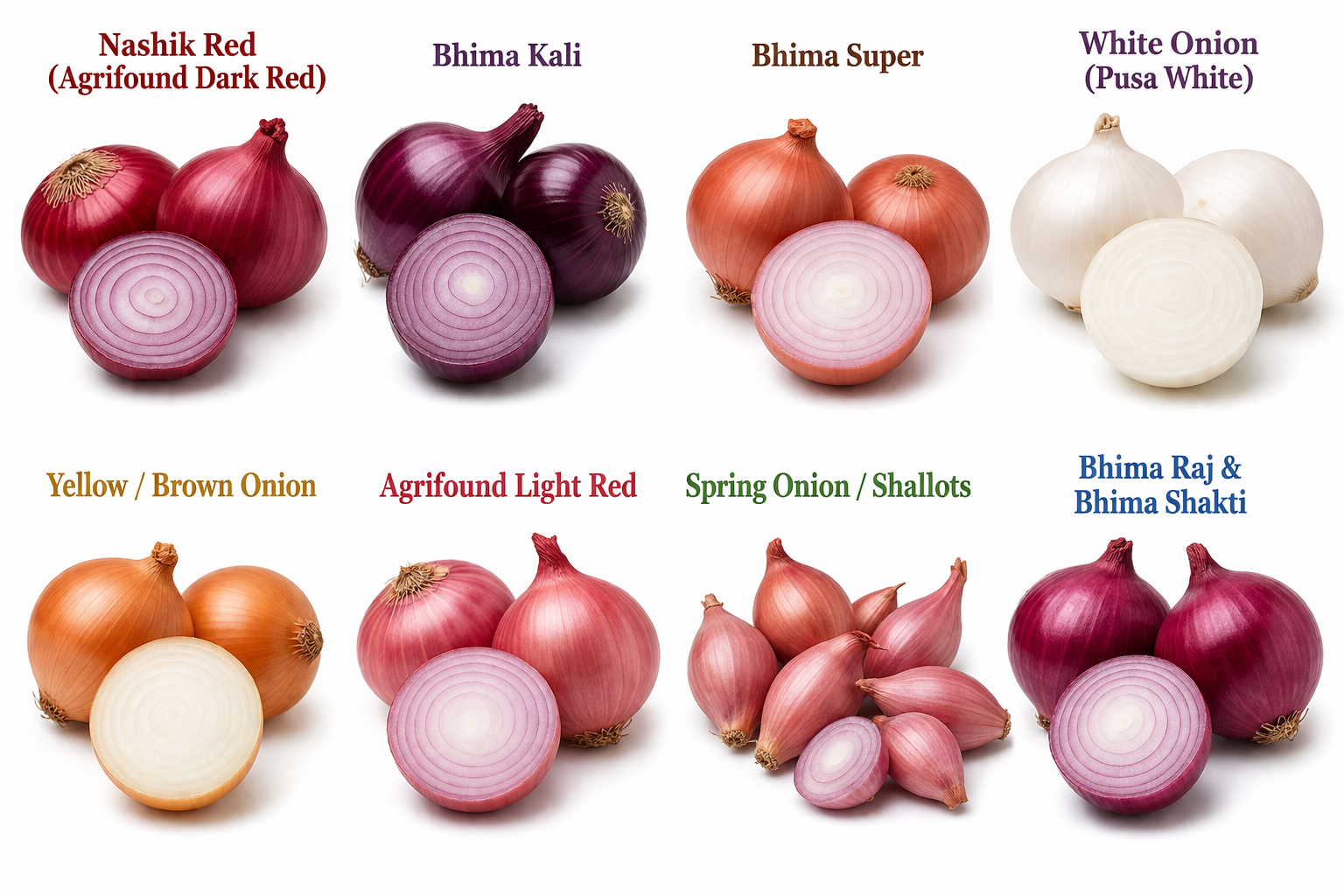
The breadth of onion varieties in India is one of the country's most underappreciated export advantages. Whatever your end market's culinary or processing requirement, there is almost certainly an Indian variety that fits it — and an experienced onion export partner who knows how to source and ship it.
Types of Onion in India — A Practical Buyer's Breakdown
When buyers talk about types of onion in India, they're often referring to two different things: the physical form of the product (fresh, processed, dehydrated) and the colour classification (red, white, yellow). Understanding both dimensions will help you specify exactly what you need in a purchase order — and avoid the classic miscommunication that sends the wrong product to your warehouse.
By Colour: Red, White, and Yellow
Red onions are by far the dominant types of onion in India — accounting for more than 70% of production and the vast majority of exports. They're preferred across South Asia, the Middle East, and Africa for their sharp flavour and long shelf life. White onions are prized for their mild sweetness and are increasingly sought after in premium export markets. Yellow onions, used extensively in processed foods, are primarily grown for domestic consumption and food-grade processing.
By Form: Fresh vs. Processed
📦 Fresh vs. Processed — What's Right for You?
| Form | Best For | Shelf Life | Typical Buyers |
| Fresh / Raw | Retail, wholesale, foodservice | 1–6 months | Supermarkets, distributors |
| Dehydrated / Dried | Spice blends, instant food, seasoning | 12–24 months | Food manufacturers, FMCG |
| Frozen (IQF) | Ready meals, restaurant chains | 12–18 months | QSR, foodservice groups |
| Pickled / Brined | Speciality retail, food gifting | 6–18 months | Gourmet retailers, delis |
| Powder / Flakes | Spice industry, processed foods | 18–24 months | Spice brands, food industry |
India exports all of the above types of onion in India in significant volumes. The dehydrated onion segment — flakes, minced, granulated, and powder — is one of the fastest-growing categories, driven by global demand from food manufacturers who need a consistent, long-shelf-life ingredient. Gujarat, in particular, has become a hub for processed onion production, with dozens of onion manufacturers in India operating food-grade dehydration plants in the region.
How to Find Reliable Onion Suppliers in India
Here's the honest truth: the Indian onion export market has many players, and the quality between them varies enormously. There are brilliant, professional exporters who maintain cold chains, document everything, and communicate proactively. And there are brokers with a smartphone and a contact list who will promise you anything and disappear when a shipment goes wrong. Identifying the good onion suppliers in India is not hard — but it requires doing some homework before you wire any money.
Step 1: Start with APEDA's Registered Exporter List
APEDA — the Agricultural and Processed Food Products Export Development Authority — maintains a list of registered onion suppliers in India who have gone through formal registration. This isn't a guarantee of quality, but it is a meaningful filter. A supplier not registered with APEDA is a red flag for serious export trade. Start here and you immediately cut out a significant portion of the noise.
Step 2: Verify Trade Certifications
Good onion suppliers in India will hold a combination of the following: FSSAI food safety certification, IEC (Importer Exporter Code) from DGFT, FIEO membership, and — for organic exports — the relevant organic certification from APEDA's empanelled certifying bodies. Ask for copies of these documents upfront. Any hesitation is worth noting.
Step 3: Request a Physical Sample Before Committing
No serious importer should place a first container order without receiving and evaluating a physical sample. A good supplier will send samples at their own cost — or at a mutually agreed courier charge. The sample should match exactly the grade, size, and variety you're ordering. If the sample is excellent but the first shipment doesn't match it, document the discrepancy immediately and address it before the second order.
✅ Checklist: What to Verify Before Working with New Onion Suppliers in India
- APEDA registration and IEC code — ask to see both documents
- FSSAI license number — verify it independently on the FSSAI portal
- Trade references from at least 2 existing international buyers
- Phytosanitary certificate capability — confirm they can arrange this for your destination
- Cold storage and grading facility — either owned or contracted with a named partner
- Physical sample matching your exact grade specification
- Payment terms you're comfortable with — avoid 100% advance with unknown partners
Step 4: Visit the Mandi (If You're Serious About Volume)
For buyers committing to regular, large-volume orders, there is no substitute for a sourcing trip to Nashik's Lasalgaon mandi or Pune's Pimpalgaon market. Seeing where the product is graded, sorted, and packed gives you an irreplaceable understanding of the supply chain. The best onion suppliers in India will welcome this visit — it's a sign of a serious, long-term buyer relationship, which is exactly what they want too.
Onion Manufacturers in India — What to Look For
The term "manufacturer" in the onion trade means something specific: companies that don't just source and ship fresh onions, but that process them — dehydrating, powdering, flaking, pickling, or freezing them for industrial or retail use. Onion manufacturers in India are a distinct category from fresh exporters, and they serve a different kind of buyer entirely.
India has some world-class onion manufacturers in India — particularly in Gujarat (Mahuva, Bhavnagar), Maharashtra (Pune, Nashik), and Rajasthan (Alwar). These operations can produce dehydrated onion flakes with specific mesh sizes, moisture levels below 5%, and pyruvic acid content controlled to meet European food standards. They're the invisible backbone behind thousands of global spice blends, instant soups, and ready meal products.
Certifications That Matter for Processed Onion
For food-grade processed onion products, the certification bar is significantly higher than for fresh exports. Serious onion manufacturers in India targeting European or North American buyers will typically hold HACCP or ISO 22000 food safety management certification, BRC or SQF certification for retail supply chains, organic certification for organic product lines, and EU residue compliance documentation. If a manufacturer can't show you at least HACCP and a recent third-party audit report, walk away.
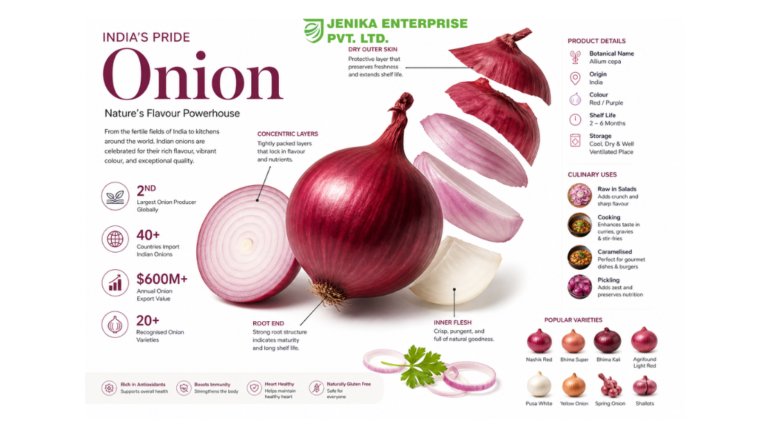
2nd
largest onion producer globally
40+
countries receive Indian onion exports
$600M+
annual onion export value
20+
recognised varieties cultivated
Where Are India's Onion Processing Hubs?
Gujarat's Saurashtra region — particularly Mahuva in Bhavnagar district — has the highest concentration of dehydration plants in the country. Maharashtra (Pune, Nashik) hosts large fresh onion grading and cold storage operations. Rajasthan's Alwar district has emerged as a significant processing cluster. If you're sourcing from onion manufacturers in India for dehydrated or processed formats, these three regions should be your first port of call.
The Onion Export Process: Documents, Standards & Shipping
India's onion export process is more structured than many buyers initially expect — which is actually good news. It means there are clear checkpoints, verifiable documents, and regulatory bodies you can hold suppliers accountable to. Here's a straightforward walkthrough of what a typical fresh onion export shipment from India looks like.
Key Documents Required
Export Documentation
- Commercial Invoice & Packing List
- Bill of Lading / Airway Bill
- Certificate of Origin (CoO)
- Phytosanitary Certificate
- APEDA Registration Certificate
Quality & Safety Docs
- FSSAI Certificate
- Pesticide Residue Test Report
- Heavy Metals Analysis (EU)
- Third-party Inspection Report
- Cold Chain Temperature Log
Destination-Specific
- Health Certificate (Gulf, EU)
- Halal Certificate (Malaysia, Indonesia)
- EUR.1 Form (UK/EU preferential)
- USDA / FDA Registration (USA)
- Organic Certificate (as required)
Key Ports for Onion Export from India
Most onion export shipments leave India through a handful of ports. Nhava Sheva (JNPT) in Mumbai handles the largest volume by far, given its proximity to Nashik and Pune. Mundra Port in Gujarat is the primary gateway for Saurashtra-sourced product and is especially relevant for processed onion. Chennai and Tuticorin serve Southern Indian exporters. For airfreight, Chhatrapati Shivaji Maharaj International Airport in Mumbai is the primary hub for premium or perishable consignments.
One Thing Most New Importers Get Wrong
The single most common mistake new buyers make in India's onion export market is not factoring in India's export policy volatility. The Indian government has, on multiple occasions, imposed minimum export prices (MEPs), export duties, or outright bans on onion exports to protect domestic supply during shortage periods. This is not hypothetical — it has happened several times in recent years and caused enormous disruption for buyers who had no contingency plan. Always have backup suppliers in Egypt, Netherlands, or Pakistan identified. Never let a single supplier account for 100% of your onion procurement.
Meet Jenika Enterprise — Your Trusted Onion Export Partner from India
We've spent this entire guide talking about what to look for in a reliable onion export partner. Now let us introduce you to one. Jenika Enterprise Pvt. Ltd is an Ahmedabad-based, APEDA and FSSAI-certified exporter of fresh fruits, vegetables, and agricultural produce — with a growing specialisation in Indian onion supply for international buyers.
We're not a broker or a middleman. We work directly with verified farm networks and grading facilities across Maharashtra, Gujarat, and Madhya Pradesh — the heart of India's onion belt. That direct access means we can offer you better pricing, tighter quality control, and more honest communication about availability than a typical trading desk. If there's a supply issue, you'll hear it from us first — not when your container arrives short.
Why Importers Choose Jenika Enterprise for Onion Export
Direct Farm Network
We source directly from verified growers in Nashik, Pune, and Madhya Pradesh — no middlemen, no inflated costs. You get farm-fresh quality at genuine farm-level pricing.
Full Documentation Support
We handle every piece of paper — phytosanitary certificates, CoO, FSSAI docs, pesticide residue reports, and destination-specific requirements. You focus on your market, we handle the paperwork.
Cold Chain Integrity
From grading shed to port, our cold-chain management ensures the onions you ordered are the onions that arrive. We provide temperature logs and pre-shipment inspection reports on request.
Global Delivery Experience
We export to the UAE, UK, USA, Malaysia, Sri Lanka, and beyond. We understand the specific import requirements of each destination — residue limits, labelling rules, and port procedures.
Proactive Communication
If there's a crop issue, a price shift, or a shipping delay — you'll hear it from us first. We believe honest, early communication is the foundation of a supplier relationship that actually lasts.
Sustainable & Organic
We work exclusively with farmers who use pesticide-free, eco-friendly farming practices. Our produce is traceable from farm to container — and we can prove it with documentation at every step.
Onion Products We Export
Ready to Source? Talk to Us Directly
Get a Free Quote from Jenika Enterprise
Tell us your destination country, required grade, and monthly volume — and we'll send you a competitive, transparent quote within 24 hours. No obligation. No pressure.
Office: K-2-4, Mahavir Nagar Complex, Shyamal Cross Road, Opp. Amul Garden, Ahmedabad, Gujarat – 380015, India
Frequently Asked Questions
India's Onion Trade Is Bigger Than You Think — and Getting Bigger
From the red fields of Nashik to the dehydration plants of Saurashtra, the onion export industry from India is a sophisticated, high-volume operation that serves buyers across six continents. Understanding the types of onion in India, knowing where the largest producer of onion in India operates, learning how to evaluate onion suppliers in India, and appreciating what good onion manufacturers in India look like — all of this puts you in a much stronger position as a buyer.
Do your due diligence, visit the source when you can, and build long-term relationships with suppliers who understand your business. If you're ready to start that journey with a certified, transparent partner — Jenika Enterprise is one WhatsApp message away.