
April 14, 2026
The global demand for fresh fruits is rapidly increasing, especially in premium markets like the United States and Europe. Among these, grapes are one of the most traded fruits due to their taste, nutritional value, and versatility. However, exporting grapes is not just about supply—it requires strict compliance with international standards.
If you are planning to enter the global market, understanding fresh grape export certification, grape export requirements in the USA, and grape export requirements in the EU is essential. This guide will help you understand everything in a simple and practical way so you can confidently export grapes to the USA and to Europe in 2026.
Why Certification is Important in Grapes Export
Exporting grapes without proper certification can lead to shipment rejection, financial loss, and long-term damage to your brand reputation. Countries like the US and EU have strict food safety laws, and compliance is non-negotiable.
To successfully meet certification standards for exporting fresh grapes, exporters must follow international guidelines related to food safety, pesticide use, and traceability. Whether you are planning to export grapes to the USA or export grapes to Europe, certifications ensure that your product is safe, high-quality, and reliable.
Additionally, meeting grape export requirements in the USA and the EU builds trust with international buyers and increases your chances of winning long-term contracts.
Understanding Grapes Export Requirements for the USA
The United States is one of the largest importers of fresh fruits. However, it has very strict compliance regulations that every exporter must follow.
To meet grape export requirements in the USA, exporters must first ensure compliance with the Food Safety Modernization Act (FSMA). This law focuses on preventing food safety issues rather than reacting to them.
If you want to export grapes to the USA, here are the key requirements:
1. FDA Registration
Every exporter must register with the US FDA. This is a basic step in fresh grape export certification.
2. Phytosanitary Certificate
This certificate confirms that your grapes are free from pests and diseases. It is mandatory under grape export documentation.
3. Pesticide Residue Compliance
The US has strict limits on pesticide residues. Meeting these limits is essential for fresh fruit export compliance.
4. Proper Labeling and Packaging
Your packaging must meet US standards, ensuring traceability and safety.
Following these steps will help you smoothly export grapes to the USA and meet all grape export requirements in the USA without delays.
Grapes Export Requirements for the European Union
The European market is highly profitable but also tightly regulated. Exporters must follow strict safety and environmental standards.
To meet grape export requirements in the EU, exporters need to comply with European food safety regulations and quality standards.
If you want to export grapes to Europe, here are the main requirements:
1. GLOBALG.A.P Certification
This certification is one of the most important certifications under fresh grape export certification. It ensures beneficial agricultural practices.
2. HACCP Certification
Hazard Analysis and Critical Control Points (HACCP) ensures food safety throughout the supply chain.
3. EU Pesticide Regulations
Strict EU pesticide residue limits for grapes must be followed. This is critical for fresh fruit export compliance.
4. Traceability System
Every shipment must be traceable from farm to buyer.
Meeting these grape export requirements in the EU will allow you to confidently export grapes to Europe and build long-term relationships with buyers.
Common Certifications Required for Both US and EU
Whether you plan to export grapes to the USA or Europe, some certifications are universally required.
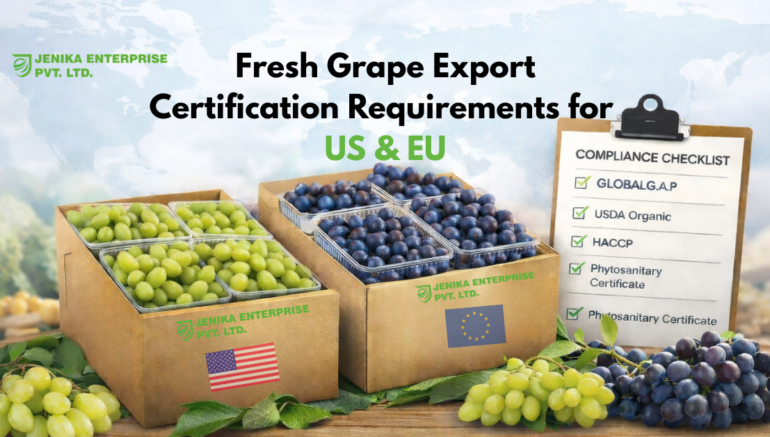
Here are the key certifications under the Fresh Grape Export Certification:
- GLOBALG.A.P Certification
- HACCP Certification
- ISO 22000
- Phytosanitary Certificate
These certifications support grape export standards for 2026 and ensure compliance with international regulations.
Having these certifications also strengthens your position in fresh fruit export compliance and increases your credibility in global markets.
Grapes Export Documentation Checklist
Proper documentation is the backbone of international trade. Missing documents can delay shipments or lead to rejection.
Here is a complete checklist for grape export documentation:
- Commercial Invoice
- Packing List
- Bill of Lading
- Certificate of Origin
- Phytosanitary Certificate
- Residue Test Report
This checklist is essential for meeting grape export requirements in the USA and in the EU.
Accurate documentation also ensures smooth execution of the grape export process and compliance with fresh fruit export standards.
Step-by-Step Grapes Export Process
Understanding the grape export process is crucial for beginners and experienced exporters alike.
Step 1: Farm Preparation
Ensure your farm follows GLOBALG.A.P. standards for fresh grape export certification.
Step 2: Harvesting and Sorting
Only high-quality grapes should be selected for export.
Step 3: Testing and Certification
Conduct laboratory tests to meet EU pesticide residue limits for grapes and US standards.
Step 4: Packaging and Cold Storage
Maintain quality through proper packaging and temperature control.
Step 5: Documentation
Prepare all grape export documentation accurately.
Step 6: Shipping and Delivery
Follow logistics protocols to successfully export grapes to the USA and to Europe.
Following this structured grape export process ensures compliance with grape export standards 2026.
Key Compliance Factors for 2026
As global regulations evolve, exporters must stay updated with grape export standards in 2026.
Here are some key compliance trends:
- Increased focus on sustainability
- Stricter EU pesticide residue limits grapes
- Enhanced traceability requirements
- Digital documentation systems
These changes directly impact fresh fruit export compliance and require exporters to upgrade their systems.
Staying ahead of these trends will help you meet grape export requirements in the USA and the EU efficiently.
Common Mistakes to Avoid
Many exporters fail due to avoidable mistakes. Here are some common errors:
- Ignoring fresh grapes export certification
- Incomplete grapes export documentation
- Not following EU pesticide residue limits grapes
- Poor cold chain management
- Lack of understanding of the grapes export process
Avoiding these mistakes will improve your success rate when exporting grapes to the USA and Europe.
Why Choose Jenika Enterprise for Grapes Export
At Jenika Enterprise, we specialize in providing high-quality grapes that meet international standards.
We ensure:
- Complete fresh grapes export certification
- Full compliance with grapes export requirements USA
- Adherence to grapes export requirements EU
- Proper grapes export documentation
- Efficient grapes export process
Our commitment to quality and compliance makes it easier for clients to export grapes to the USA and export grapes to Europe without hassle.
Future of Grapes Export Industry
Experts anticipate significant growth in the global fruit export market in the coming years. With increasing demand, exporters who follow grape export standards in 2026 will have a competitive advantage.
Focus on:
- Sustainable farming
- Advanced logistics
- Strong fresh fruit export compliance
- Meeting EU pesticide residue limits grapes
These factors will shape the future of the grape export process and global trade.
Conclusion for Fresh Grape Export Certification Requirements for US & EU
Exporting grapes to international markets like the US and EU requires careful planning, strict compliance, and proper documentation.
By understanding fresh grape export certification, following USA grape export requirements, and meeting EU grape export requirements, you can successfully export grapes to the USA and Europe.
Make sure to follow the correct grape export process, maintain proper grape export documentation, and stay updated with grape export standards 2026 to ensure long-term success in the global market.
Are you ready to import premium-quality grapes with full certification?
Partner with Jenika Enterprise for export-ready fresh grapes that meet all US & EU standards.
Get your bulk quote today and simplify your import process!
Call Us: +91 8160035023
Visit our website: Click here.
FAQ
1. What certifications are required for exporting fresh grapes to the US and EU?
To meet certification standards for exporting fresh grapes, exporters need certifications like GLOBALG.A.P., HACCP, ISO 22000, and a phytosanitary certificate. For the US, FDA registration is also mandatory, while EU exports must comply with strict pesticide residue regulations.
2. What are the main grape export requirements in the USA?
The key grape export requirements in the USA include FDA registration, compliance with the Food Safety Modernization Act (FSMA), pesticide residue limits, proper labeling, and complete export documentation.
3. What are the grape export requirements in the EU?
The EU grape export requirements include GLOBALG.A.P. certification, HACCP compliance, strict EU pesticide residue limits, and a strong traceability system to ensure product safety and quality.
4. What documents are required for exporting grapes internationally?
Essential grape export documentation includes a commercial invoice, packing list, bill of lading, certificate of origin, phytosanitary certificate, and residue test report.
5. How can I export grapes to the USA and Europe successfully?
To successfully export grapes to the USA and Europe, you must follow the correct export process, obtain all certifications, maintain cold chain logistics, and ensure compliance with international standards.
According to APEDA, India continues to be a leading exporter of fresh grapes, with exports reaching 271,253.89 metric tons valued at USD 353.54 million in FY 2024–25, highlighting strong global demand.