
April 18, 2026
Why Oranges Are Such a Big Deal in India
If you've ever walked through a sabzi mandi in December, you know the feeling — that rush of cold air carrying the faint sweetness of fresh citrus, stalls piled high with bright orange fruit. For most Indians, the arrival of oranges in the market is a quiet signal that winter has officially begun. It's one of those small, seasonal rituals we rarely talk about but never forget.
But here's something most people don't realise: that "orange" sitting in your fruit bowl might be a completely different fruit from the one your neighbour just brought home. Indian orange fruit is not a single thing — it's a whole world of cultivars, each grown in a specific region, with its own sweetness, texture, and personality.
India ranks among the world's top citrus producers, yet most consumers are barely aware of this diversity. This guide is here to change that. Whether you're a farmer looking to expand your crop, a foodie curious about where your fruit comes from, or simply someone who loves a good orange — understanding the orange varieties in India will genuinely change the way you shop, eat, and think about this beautiful fruit.
We'll walk through everything — the major orange varieties in India, the different types, the best times to buy, growing states, and tips to always pick the juiciest one off the pile. Let's get started.
Major Orange Varieties in India
The story of orange varieties in India is really a story about geography. A mandarin grown in the cool altitudes of Meghalaya tastes nothing like the one cultivated on the sun-baked plains of Vidarbha — and that's a beautiful thing. Here are the varieties that matter most, from the household names to the hidden gems.
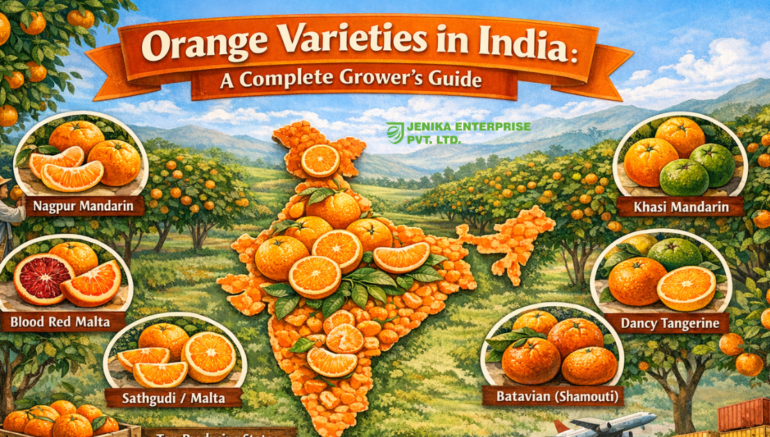
Nagpur Mandarin
This is the one everyone talks about — thin-skinned, nearly seedless, and outrageously sweet. Grown in Vidarbha, Maharashtra, and the proud holder of a GI tag. The Indian orange fruit most people picture when they close their eyes.
Kinnow
A mandarin hybrid that punches above its weight — deep orange rind, rich tangy juice, and an almost addictive flavour. Punjab and Haryana's juicers swear by it. If you've ever had a fresh glass of orange juice in Amritsar, this was probably it.
Khasi Mandarin
Small, slightly tart, and wonderfully fragrant. Grown in the mist-covered hills of Meghalaya and Assam. It ripens earlier than most other varieties — a welcome treat before the main winter crop arrives.
Sathgudi (Malta)
Andhra Pradesh's pride. This sweet orange is practically designed for juicing — high yield, mild sweetness, and very little bitterness. Called "Malta" in the north and "Sathgudi" down south. Either way, it's delicious.
Coorg Mandarin
From the coffee and spice country of Kodagu, Karnataka. Loose-skinned, easy to peel, and beautifully balanced between sweet and tart. A firm favourite across South Indian households during the festive season.
Blood Red Malta
A showstopper. Grown at high altitudes in Himachal Pradesh, its flesh blushes deep red — almost like a blood orange from Sicily. Tangy, complex, and premium-priced. If you spot it at a market, buy it.
Batavian (Shamouti)
Thick-skinned and travel-friendly, with a clean, uncomplicated sweetness inside. Still finding its footing in Tamil Nadu and Kerala, but the initial response from growers and consumers has been very positive.
Dancy Tangerine
A bright red-orange mandarin that somehow thrives in Rajasthan's dry, arid conditions. Spicy-sweet flavour, easy to peel, and a great example of how adaptable Indian citrus cultivation really is.
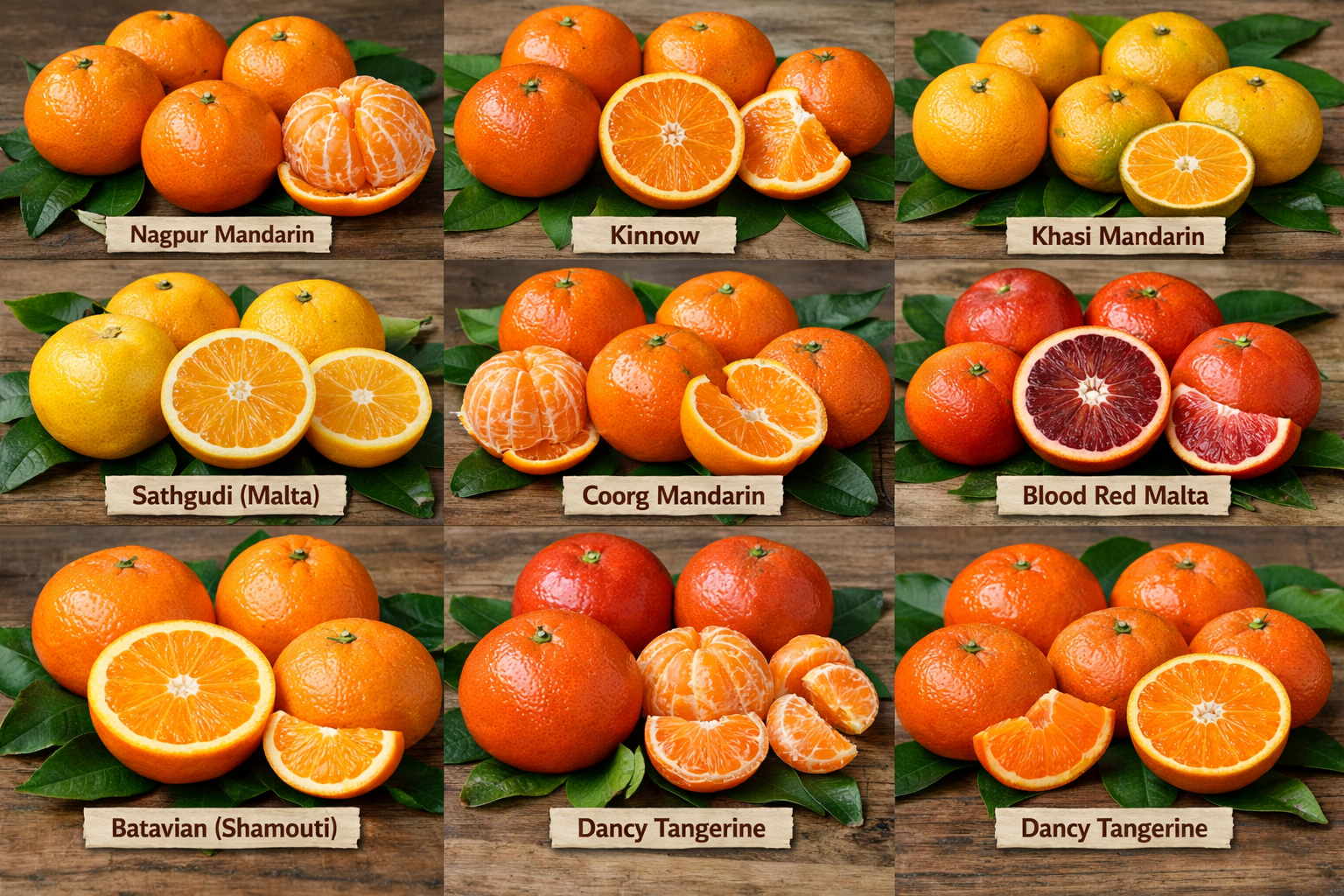
These aren't just fruit — they're a reflection of India's incredible agricultural diversity. And the list doesn't end here. As consumers get more curious and farmers experiment more boldly, the world of orange varieties in India keeps growing every year.
Types of Oranges in India — What's the Difference?
People often use the word "orange" as though it means one thing. It doesn't — at least not in India. There are three broad groups within the types of oranges in India, and knowing which is which will save you from a lot of market disappointment.
1. Mandarin Oranges — The Easy-Peel Crowd-Pleasers
Mandarins are what most Indians actually mean when they say "संतरा" (santra). The skin is loose, the segments separate cleanly, and there's very little fuss. These are the types of oranges in India you peel while watching cricket, share at the office, or pile into a bowl during Diwali. Nagpur Mandarin, Kinnow, Khasi Mandarin, and Coorg Mandarin all belong here. They're brilliant for fresh eating, gifting, and temple offerings.
2. Sweet Oranges — Built for the Juicer
Sweet oranges have a firmer, tighter skin that clings to the fruit. You wouldn't peel one by hand at a roadside stall — but run it through a juicer and you'll get something spectacular. Called "Malta" in UP and Bihar, "Sathgudi" in Andhra, these types of oranges in India power the country's juice industry. Sathgudi, Blood Red Malta, and Batavian all fall here.
3. Hybrids and New Varieties — The Future of Indian Citrus
This is where things get exciting. India's National Research Centre for Citrus (NRC Citrus) in Nagpur has been quietly developing new cultivars that combine the sweetness consumers love with the disease resistance farmers need. Kinnow itself is a hybrid — a cross between King and Willow Leaf mandarins. Expect more of these innovative types of oranges in India to enter mainstream markets in the coming years.
Quick Comparison: Mandarin vs. Sweet Orange
Orange Fruit Season in India (Month-by-Month)
Ask any fruit vendor and they'll tell you: buying an orange out of season is a gamble you rarely win. Knowing the orange fruit season in India is probably the single most useful thing you can learn if you want great-tasting citrus at a fair price. The good news? India's size and diversity mean that unlike in many countries, there's no single narrow window — there's something happening almost all year.
ⓘ Peak Season · ⓘ Available (Northeast crop) · ⓘ Off Season
The Ambe Bahar Season (September–October)
Here's a farming trick you might not know about. In Maharashtra and parts of Karnataka, growers deliberately stress their trees during summer — withholding water and nutrients — to trigger early flowering in September. The resulting harvest, called Ambe Bahar, extends the effective season of orange in India well beyond winter. Because supply is lower during this window, these fruits often fetch higher prices at the mandi, making it an attractive strategy for experienced farmers.
The Mrig Bahar Season (October–January) — The Big One
This is the main event — the orange season India runs on. Trees flower during the June–July monsoon and the fruit ripens October through January. This is when Nagpur Mandarin and Kinnow flood every market in the country, prices become affordable for everyone, and quality is simply at its peak. If you're only going to buy oranges once a year, do it between November and December.
The Northeast's Early Harvest (July–October)
Meghalaya and Assam don't follow the same calendar as the rest of the country. The Khasi Mandarin ripens much earlier — from July to October — bridging the gap between last year's winter crop and the new one. This staggered orange fruit season in India means that some corner of the country is always producing fresh Indian orange fruit for the national market. It's a beautiful, unplanned coordination across thousands of miles.
Orange Production in India
Orange production in India is a quietly massive industry. India produces around 10–11 million metric tonnes of total citrus each year, with mandarin oranges making up the biggest slice. It's not just a domestic story either — Nagpur Mandarin and Kinnow are exported to the UAE, the UK, the Netherlands, and Bangladesh, meaning that orange production in India is slowly making its mark on the global citrus map.
| State | Key Variety | Season | Share |
|---|---|---|---|
| Maharashtra (Nagpur) | Nagpur Mandarin | Oct – Feb | ~30% |
| Punjab & Haryana | Kinnow | Dec – Mar | ~25% |
| Meghalaya & Assam | Khasi Mandarin | Aug – Oct | ~15% |
| Andhra Pradesh | Sathgudi | Nov – Jan | ~10% |
| Karnataka (Kodagu) | Coorg Mandarin | Nov – Jan | ~8% |
| Himachal Pradesh | Blood Red Malta | Nov – Feb | ~5% |
| Rajasthan & MP | Mixed Varieties | Oct – Jan | ~7% |
The government has been steadily backing this sector through the National Horticulture Mission (NHM), which funds drip irrigation systems, cold storage units, and improved nursery stock. NRC Citrus in Nagpur continues to release disease-resistant rootstocks that help farmers get more from each tree while protecting their orchards from the citrus greening disease that has devastated crops in other parts of the world.
The single biggest challenge in orange production in India right now? Post-harvest losses. Up to 30% of fruit never makes it from orchard to consumer in acceptable condition — a heartbreaking waste that better cold-chain infrastructure could solve. Initiatives to close this gap are underway, and the results over the next decade will shape just how much of the world gets to taste Indian orange fruit.
Key Facts: Orange Production in India
- India ranks among the top 7 citrus producers in the world by volume.
- Maharashtra, Punjab, and Meghalaya together contribute over 70% of the national output.
- Nagpur Mandarin holds a GI (Geographical Indication) tag — one of India's most prized agricultural certifications.
- The orange processing industry (juice, pulp, peel oil) is expanding at roughly 8% CAGR annually.
- Post-harvest losses run between 20–30% — a challenge the industry is actively working to address.
How to Pick the Best Indian Orange Fruit
Now that you know your types of oranges in India like a pro, let's make sure you're always picking the best one from the pile. These are simple, practical tips — the kind that fruit vendors learn after years at the stall.
Pick the Heaviest One You Can Find
Weight equals juice. A great Indian orange fruit should feel surprisingly heavy for its size — that denseness tells you the cells are packed with liquid. A light orange, even a visually perfect one, is often a disappointment.
Look at the Skin — But Don't Judge Too Harshly
Smooth and slightly glossy is a good sign. But don't reject a Nagpur Mandarin for having a slightly rough or bumpy skin — that's completely normal for the variety and says nothing about the taste inside. What you do want to avoid is a wrinkled, sunken-looking rind, which usually means the fruit has lost moisture.
Smell the Stem End
Turn the orange over and give the stem end a quick sniff. A fresh, in-season orange will have a faint but unmistakably citrusy aroma even through its rind. No smell usually means it's been in cold storage for too long. A sour, fermented smell means it's past its best.
Always Buy In-Season
This one can't be overstated. Shopping during the peak season of orange in India — November through January — gives you the best fruit at the lowest prices, often 30–40% cheaper than out-of-season purchases. Out-of-season fruit is almost always cold-stored or imported, and you'll taste the difference.
Match the Variety to What You Need
Want to peel and eat it on the sofa? Go for Nagpur Mandarin or Coorg Mandarin. Making fresh juice? Pick Sathgudi or Kinnow. Baking or cooking? Blood Red Malta's complex flavour is worth exploring. Among all the types of oranges in India, there's always one that's exactly right for what you have in mind.
Role of Exporters in Indian Orange Trade
With global demand rising, India’s citrus industry is expanding beyond domestic markets. This is where trusted exporters play a critical role.
Companies like Jenika Enterprise Pvt. Ltd. are helping bridge the gap between Indian farmers and international buyers. By focusing on quality sourcing, proper grading, and efficient logistics, they ensure that fresh Indian oranges reach markets like the UAE, Europe, and Southeast Asia in premium condition.
For global importers, working with reliable exporters ensures the following:
- Consistent quality supply
- Proper packaging & cold chain management
- Compliance with international standards
Frequently Asked Questions
There's a Whole World in That Orange
From the iconic Nagpur Mandarin to the rare Blood Red Malta, orange varieties in India reflect the country’s agricultural richness. Understanding the types, seasons, and sourcing of Indian oranges doesn’t just help you buy better fruit — it helps you appreciate the journey behind every bit. And as exporters like Jenika Enterprise Pvt. Ltd. continue to take these fruits to global markets, the world is slowly discovering what India has always known — there’s something truly special about an Indian orange.
Explore More Powerful Solutions by Clearzone
From agriculture protection to hygiene solutions — we cover every industry.